'%3E%3Cg%3E%3Cpath d='M20.1235 56.7913L15.4557 67.1602H17.4422L18.4666 64.7639H23.651L24.6844 67.1602H26.6976L22.012 56.7913H20.1146H20.1235ZM19.1169 63.2496L21.0588 58.7154L23.0186 63.2496H19.1258H19.1169Z' fill='%237B7D7E'/%3E%3Cpath d='M47.5245 62.5636C47.5245 64.7016 46.5803 65.6191 44.9056 65.6191C43.2309 65.6191 42.2688 64.7016 42.2688 62.5636V56.7823H40.3447V62.6349C40.3447 65.6547 42.0461 67.3027 44.8967 67.3027C47.7472 67.3027 49.4308 65.6547 49.4308 62.6349V56.7823H47.5334V62.5636H47.5245Z' fill='%237B7D7E'/%3E%3Cpath d='M63.2204 58.4214H66.6589V67.1602H68.583V58.4214H72.0215V56.7913H63.2204V58.4214Z' fill='%237B7D7E'/%3E%3Cpath d='M90.7906 56.6398C87.5749 56.6398 85.2053 58.9024 85.2053 61.9757C85.2053 65.0489 87.5749 67.3116 90.7906 67.3116C94.0064 67.3116 96.376 65.0578 96.376 61.9757C96.376 58.8935 94.0064 56.6398 90.7906 56.6398ZM90.7906 65.619C88.6973 65.619 87.1473 64.0958 87.1473 61.9757C87.1473 59.8556 88.7062 58.3323 90.7906 58.3323C92.8751 58.3323 94.434 59.8556 94.434 61.9757C94.434 64.0958 92.8751 65.619 90.7906 65.619Z' fill='%237B7D7E'/%3E%3Cpath d='M120.802 56.7913L116.757 63.6593L112.642 56.7913H111.056V67.1602H112.891V60.3723L116.294 65.9754H117.158L120.561 60.2832L120.579 67.1602H122.405L122.387 56.7913H120.802Z' fill='%237B7D7E'/%3E%3Cpath d='M142.671 56.6398C139.455 56.6398 137.085 58.9024 137.085 61.9757C137.085 65.0489 139.455 67.3116 142.671 67.3116C145.887 67.3116 148.256 65.0578 148.256 61.9757C148.256 58.8935 145.887 56.6398 142.671 56.6398ZM142.671 65.619C140.577 65.619 139.027 64.0958 139.027 61.9757C139.027 59.8556 140.586 58.3323 142.671 58.3323C144.755 58.3323 146.314 59.8556 146.314 61.9757C146.314 64.0958 144.755 65.619 142.671 65.619Z' fill='%237B7D7E'/%3E%3Cpath d='M161.449 58.4214H164.887V67.1602H166.812V58.4214H170.25V56.7913H161.449V58.4214Z' fill='%237B7D7E'/%3E%3Cpath d='M186.258 56.7913H184.334V67.1602H186.258V56.7913Z' fill='%237B7D7E'/%3E%3Cpath d='M205.686 64.7906L202.23 56.7913H200.145L204.679 67.1602H206.577L211.093 56.7913H209.169L205.686 64.7906Z' fill='%237B7D7E'/%3E%3Cpath d='M226.745 65.5478V62.6884H231.751V61.1027H226.745V58.4036H232.383V56.7913H224.812V67.1602H232.597V65.5478H226.745Z' fill='%237B7D7E'/%3E%3C/g%3E%3Cg%3E%3Cpath d='M82.3281 12.7323H93.7036V42.4583H100.474V12.7323H111.849V6.5769H82.3281V12.7323Z' fill='%2352AFE3'/%3E%3Cpath d='M154.091 18.4691C154.091 12.2691 149.628 6.63033 141.174 6.57689C135.482 6.57689 129.799 6.52344 124.107 6.52344V42.4583H130.868V30.4681H137.736L148.14 42.4583H155.881V41.9951L145.014 29.7466C151.828 28.3659 154.082 23.3863 154.082 18.4691H154.091ZM130.868 24.3662V12.8837H141.174C145.432 12.8837 147.33 15.7521 147.33 18.6205C147.33 21.4889 145.486 24.3573 141.174 24.3573H130.868V24.3662Z' fill='%2352AFE3'/%3E%3Cpath d='M192.841 27.1899C192.841 33.3364 189.661 37.0867 184.075 37.0867C178.49 37.0867 174.793 33.6482 174.793 27.1899V6.63025H168.076V27.1899C168.076 38.0042 175.408 43.2332 184.022 43.2332C192.636 43.2332 199.548 37.7993 199.548 27.1899V6.63025H192.832V27.1899H192.841Z' fill='%2352AFE3'/%3E%3Cpath d='M241.585 13.1421V6.5769H214.728V42.4583H241.585V35.7951H221.444V27.6978H240.873V21.3909H221.444V13.1421H241.585Z' fill='%2352AFE3'/%3E%3C/g%3E%3Cpath d='M68.1732 6.53235H66.3916V42.4672H68.1732V6.53235Z' fill='%237B7D7E'/%3E%3Cg%3E%3Cg%3E%3Cpath d='M22.7335 2.33658C22.8315 1.77537 22.9028 1.19635 23.1789 0.688599C24.6309 0.706415 26.074 0.688599 27.526 0.688599C27.7933 0.688599 28.0605 0.733139 28.3278 0.759863C28.6841 1.3567 28.7999 2.05152 28.8712 2.72853C28.889 3.18284 28.8979 3.62824 28.9691 4.08255C30.1183 4.29634 31.2585 4.54576 32.372 4.91099C32.8441 5.06243 33.3162 5.24949 33.7884 5.39202C34.4119 4.50122 34.9375 3.48571 35.8728 2.87106C35.9708 2.79089 36.0866 2.81761 36.1846 2.87106C37.6277 3.64605 39.053 4.43887 40.407 5.3653C40.4515 6.53225 39.7656 7.53885 39.3291 8.57218C40.024 9.19574 40.7188 9.8193 41.3602 10.5052C41.8768 11.013 42.3133 11.5831 42.8122 12.0997C43.4357 11.788 44.0504 11.4495 44.7185 11.2268C45.1728 11.0753 45.636 10.915 46.117 10.9239C46.9633 12.4115 47.8274 13.8903 48.6647 15.3868C47.9521 16.3043 46.9722 16.9635 46.0101 17.5782C46.3576 18.6204 46.7139 19.6626 46.9544 20.7316C47.0969 21.2928 47.1771 21.8629 47.2929 22.433C48.255 22.4865 49.2527 22.4597 50.1702 22.7983C50.3394 22.8695 50.5265 22.9319 50.6601 23.0655C50.7403 23.3327 50.7314 23.6089 50.7403 23.8761C50.767 25.1945 50.7581 26.504 50.7314 27.8224C50.7492 28.0629 50.4998 28.1876 50.3305 28.2945C49.4219 28.7844 48.3529 28.6686 47.3552 28.8112C47.0524 29.693 46.9009 30.6106 46.6426 31.5014C46.4466 32.2051 46.2239 32.8999 46.028 33.6037C46.8653 34.245 47.8897 34.6904 48.4955 35.5901C48.6469 35.7594 48.5222 35.9732 48.4509 36.1513C48.1926 36.7215 47.8096 37.2203 47.5245 37.7637C47.0078 38.6099 46.6604 39.5987 45.9122 40.2757C44.8076 40.1065 43.801 39.6076 42.8122 39.1177C42.5806 39.3137 42.4113 39.5631 42.2064 39.7947C41.3958 40.7301 40.505 41.603 39.5429 42.3869C39.4539 42.4671 39.3737 42.5473 39.2935 42.6453C39.7211 43.5183 40.2556 44.3734 40.3714 45.3533C40.3803 45.5671 40.4515 45.87 40.211 45.9947C39.2846 46.6361 38.3047 47.1884 37.3159 47.7317C36.8616 47.9633 36.4251 48.2395 35.953 48.4266C35.0533 47.8654 34.5545 46.8944 33.9131 46.0927C33.8151 45.9501 33.628 46.0036 33.4855 46.0036C32.4611 46.1283 31.5257 46.645 30.5013 46.7519C30.4746 45.6918 30.4211 44.6407 30.4568 43.5806C30.4479 43.4648 30.5548 43.4025 30.6528 43.3846C36.1757 41.8525 40.9326 37.6568 42.9636 32.2764C43.1952 31.7152 43.3288 31.1183 43.5337 30.5482C43.7653 29.9603 43.8188 29.3278 43.9168 28.7043C44.0237 27.8491 44.1038 26.9939 44.1216 26.1298C44.2196 24.9273 44.2018 23.7158 43.9702 22.5221C43.4446 19.4132 42.0995 16.4558 40.122 14.0061C38.3849 11.8414 36.1401 10.0954 33.628 8.91068C31.0803 7.7081 28.2654 7.11127 25.4505 7.16471C21.1657 7.22707 16.9255 8.84833 13.7008 11.6722C10.4049 14.5049 8.17787 18.5491 7.5454 22.8517C7.24253 24.8827 7.28707 26.9494 7.64339 28.9715C8.24023 32.1427 9.67441 35.1626 11.8034 37.6033C13.7097 39.8125 16.1505 41.5496 18.8407 42.6631C19.5712 42.9749 20.3284 43.1887 21.0767 43.4381C21.0767 44.5338 21.0856 45.6384 21.0767 46.734C19.9632 46.6093 18.9298 46.0927 17.8252 45.9056C17.077 46.7697 16.4801 47.7941 15.5537 48.4978C14.075 47.6159 12.525 46.8588 11.1086 45.8789C11.0552 44.6674 11.8034 43.6519 12.2399 42.5829C10.9483 41.5496 9.7724 40.3648 8.68563 39.1177C8.06207 39.4384 7.4296 39.7324 6.77041 39.964C6.36955 40.0976 5.97759 40.2668 5.55001 40.3114C4.70375 39.0732 4.00893 37.7548 3.3141 36.4275C3.20721 36.1959 3.02014 35.9732 2.99341 35.7149C3.40318 35.1536 3.93766 34.6993 4.48996 34.2807C4.82846 34.0134 5.22041 33.8264 5.55892 33.5502C5.11352 32.4367 4.73938 31.2876 4.48105 30.1206C4.39197 29.702 4.33852 29.2833 4.24053 28.8735C3.14485 28.5974 1.92446 28.7043 0.935667 28.1074C0.935667 26.4505 0.597163 24.7847 0.873311 23.1368C0.873311 23.012 1.00693 22.9764 1.0871 22.9319C2.06698 22.4687 3.18048 22.4865 4.24053 22.433C4.32961 22.1302 4.35634 21.8184 4.40979 21.5155C4.66812 20.1882 5.07789 18.8876 5.55001 17.6227C5.3184 17.4 5.02444 17.2575 4.76611 17.0704C4.11582 16.6339 3.48335 16.144 2.98451 15.5293C2.83307 15.3957 2.98451 15.2265 3.05577 15.0839C3.87531 13.7032 4.65921 12.3046 5.46984 10.9239C6.63679 11.0041 7.67902 11.5831 8.69453 12.1087C9.18447 11.6009 9.62097 11.0575 10.1287 10.5676C10.7968 9.86384 11.5273 9.22246 12.2577 8.58999C11.8034 7.55667 11.1175 6.55006 11.1086 5.38311C12.4537 4.4745 13.879 3.69059 15.3132 2.93341C15.4379 2.87106 15.5982 2.77307 15.7229 2.88887C16.6494 3.50353 17.1393 4.54576 17.8252 5.38311C19.2416 4.91099 20.6669 4.43887 22.1367 4.17163C22.297 4.1449 22.4663 4.10927 22.6266 4.07364C22.6445 3.49462 22.689 2.9156 22.7514 2.33658' fill='%2352AFE3'/%3E%3C/g%3E%3Cg%3E%3Cpath d='M16.6048 12.8302C19.6246 10.5587 23.5174 9.463 27.2855 9.88167C30.7151 10.2202 34.0022 11.7791 36.4429 14.2021C38.3849 16.1173 39.7834 18.5759 40.4605 21.2305C41.28 24.3661 41.0127 27.76 39.7834 30.7531C38.1444 34.7973 34.6257 37.9775 30.5102 39.3939C30.4835 39.3048 30.4746 39.2068 30.4657 39.1088C30.4657 38.2358 30.4835 37.3539 30.4657 36.481C30.3944 35.7861 30.4479 35.0824 30.3588 34.3876C30.6438 34.1649 30.9734 34.0224 31.2763 33.8264C32.2295 33.2117 33.1024 32.4635 33.8151 31.5816C34.599 30.5037 35.1869 29.2744 35.5521 27.9916C36.3093 25.3638 35.9174 22.4241 34.4832 20.0902C33.8507 19.0391 33.0312 18.0949 32.078 17.3199C31.8286 17.115 31.5792 16.9101 31.2852 16.7676C31.2407 19.244 31.2763 21.7204 31.2763 24.1968C31.303 24.4106 31.0536 24.4819 30.9111 24.5799C29.2631 25.4974 27.6775 26.5307 25.9671 27.3414C24.6042 26.6911 23.3215 25.8804 22.012 25.1322C21.5755 24.8649 21.1034 24.6511 20.6847 24.3572C20.6758 21.7293 20.6847 19.1015 20.6758 16.4647C20.3373 16.5983 20.0344 16.821 19.7404 17.0437C17.7451 18.5135 16.2574 20.7049 15.7318 23.1368C15.1083 25.7825 15.7229 28.6241 17.1839 30.8956C17.7451 31.7597 18.529 32.4456 19.2238 33.185C19.7583 33.6393 20.4709 33.8531 20.9697 34.3698C21.0232 34.5836 20.9965 34.8063 21.0054 35.02C21.0054 36.4721 20.9787 37.9241 20.9697 39.385C18.0123 38.4051 15.3043 36.5344 13.5138 33.9689C13.2287 33.577 13.006 33.1405 12.7299 32.7396C12.1152 31.8755 11.6698 30.8867 11.3402 29.8801C10.7701 28.1074 10.4227 26.2368 10.5296 24.3661C10.6097 22.3529 11.1086 20.3664 11.9638 18.5403C12.9971 16.2865 14.6183 14.309 16.6048 12.8302Z' fill='%237B7D7E'/%3E%3C/g%3E%3C/g%3E%3C/g%3E%3Cdefs%3E%3CclipPath%3E%3Crect width='240.837' height='66.6229' fill='white' transform='translate(0.748596 0.688599)'/%3E%3C/clipPath%3E%3C/defs%3E%3C/svg%3E)
Brakes are polite. Before they fail, they almost always make a noise first. A squeak, a squeal, a grind, a shudder: each one means something different, and learning the difference can save you money and keep you safe. Here is a translation guide for the most common brake noises.
Squeaking on the First Few Stops of the Morning
Hear a light squeak or scrape on the first couple of stops after a rainy night or a humid Georgia morning, and then it goes away? That is usually normal. Brake rotors are bare iron, and a thin layer of surface rust forms overnight when they get damp. The pads wipe it off within a few stops. If the noise disappears quickly, you can relax. If it sticks around all day, read on.
A High-Pitched Squeal When You Brake
Many brake pads have a small metal tab called a wear indicator. When the pad material gets thin, the tab touches the rotor and squeals on purpose. It is the brake system's version of a smoke alarm chirping for a new battery. It means it is time to schedule brake service soon, before the pads wear down to metal.
Squealing can also come from glazed pads after hard use, missing anti-rattle hardware or pads that do not suit the car. A technician can tell which it is by looking at the pads.
Grinding: Do Not Wait on This One
A harsh grinding or growling sound when you brake usually means the pad material is gone and the metal backing plate is scraping the rotor. Metal on metal stops poorly and chews up rotors quickly. A pad replacement can turn into pads, rotors and sometimes calipers. Grinding means book the visit now, and drive gently until then.
Grinding can also come from a small stone stuck between the rotor and the dust shield. That one is a quick fix, but you will not know which it is until someone looks.
Other Brake Warning Signs
- Pulsing pedal or a shaking steering wheel when braking. Usually rotors with uneven thickness, often from heat. See our post on a car that shakes for more.
- Car pulls to one side when braking. A sticking caliper, a collapsed brake hose or uneven pad wear.
- Soft or spongy pedal. Air or moisture in the fluid, or a leak. This is a safety issue: have it checked right away.
- Pedal sinks toward the floor. Stop driving and call for a tow.
- Brake warning light. Low fluid, worn pad sensors on many European cars, or a hydraulic problem.
- Burning smell after a long downhill. Overheated brakes. Let them cool. If it happens in normal driving, a caliper may be dragging.
Do Not Forget the Brake Fluid
Brake fluid absorbs moisture from the air over time, and Georgia air has plenty to offer. Water in the fluid lowers its boiling point and corrodes parts inside the calipers and ABS unit. Many manufacturers call for a brake fluid change every two years or so, regardless of mileage. Check your owner's manual or maintenance booklet for your car's interval. Our car fluids guide has more.
How Long Do Brakes Last?
It depends far more on how and where you drive than on a calendar. Stop-and-go traffic, hilly neighborhoods and heavy vehicles wear brakes faster. Performance cars, including many BMWs, Audis and Porsches, use softer pads that grip hard and wear faster, and many European cars are designed to replace rotors along with pads. A brake inspection at each tire rotation is the easiest way to avoid surprises.
Pads, Rotors and Calipers in Plain English
- Pads are the friction material that squeezes the rotor. They are designed to wear out.
- Rotors are the metal discs the pads squeeze. They wear too, and must stay above a minimum thickness stamped on them.
- Calipers are the clamps that hold the pads and push them against the rotors with hydraulic pressure.
A good brake job measures all three, cleans and lubricates the slide pins and hardware and checks the fluid. Skipping those steps is how brakes start squeaking again a month later.
About That Photo
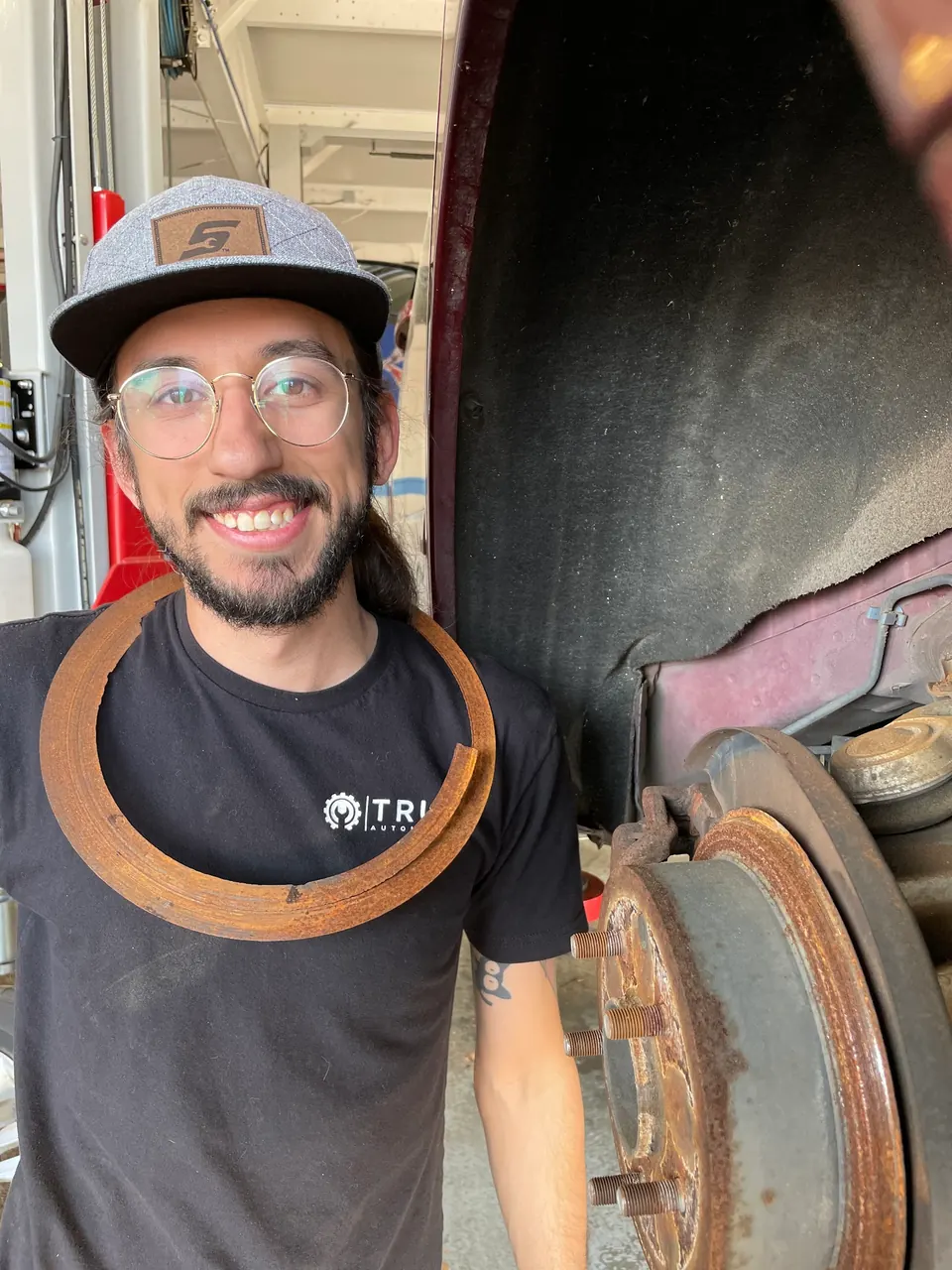
Look past the rusty ring our technician is modeling as a necklace, and you will see a brake rotor on the hub that has seen a lot of weather. Rust, heat and time can wear brake parts past the point of a simple repair. Most people would rather keep their brake parts on the car than wear them as jewelry, so do not wait on the noises above.
For more, see our brake repair page.
Brake Repair in Metro Atlanta
If your brakes squeak, grind, pulse or feel soft, have them inspected before the noise turns into a bigger repair. Our technicians will measure your pads and rotors and show you what they find. TRUE Automotive has auto repair shops in Decatur, Lawrenceville, Marietta, Sandy Springs and Woodstock. Book service online or call the shop nearest you.